Arashiyama in One Day: Five Tickets, One Free Path and a Hike Nobody Warns You About
Updated September 17, 2026 · 8 min read
Arashiyama is the second thing people plan after the temples, and it is planned wrong more often than anything else in Kyoto — because it looks like one place and it is five, each with a separate ticket, a separate calendar and, in one case, a twenty-minute climb that no photograph of the bamboo ever shows.
Here is what a day there actually consists of.
The famous part is free, and it is short
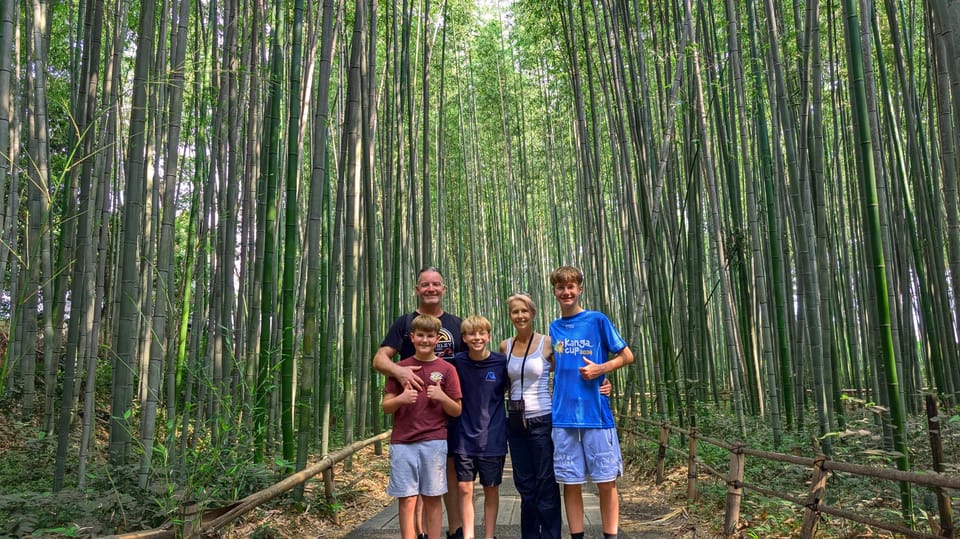
The bamboo grove has no gate, no ticket and no closing time. It is a public path through a stand of bamboo, and walking its main stretch takes something between ten and fifteen minutes at a normal pace.
That is the single most useful fact about Arashiyama, and it cuts both ways. Nobody can sell you entry to it — if a tour lists “bamboo grove entry” as an inclusion, there is nothing to include. And because it is free and short, it is also the most crowded twelve minutes in west Kyoto from mid-morning onwards.
What you pay for in Arashiyama is everything around it.
Tenryū-ji has the same trap as Nijō Castle
The temple at the edge of the grove is a UNESCO World Heritage site and the head temple of its Rinzai branch. Its ticketing repeats the pattern that ruins plans across the city: the grounds and the single room you came for are different tickets.
From the temple’s own admission page:
| Price | Note | |
|---|---|---|
| Garden only | ¥500 | high school age and above |
| Garden, elementary and middle school | ¥300 | preschool children free |
| Buildings (Ōhōjō) | + ¥300 | on top of the garden fee |
| Cloud Dragon in the Dharma Hall | ¥500 | separate again |
Opening is 8:30 am to 5 pm, last admission 4:50 pm.
The Cloud Dragon is the catch. The painting on the Dharma Hall ceiling — the thing most visitors have actually seen a picture of — is open Saturdays, Sundays and public holidays only, plus two periods when the temple opens it daily: in 2026, 1 March to 31 May and 19 September to 6 December. Turn up on a Wednesday outside those weeks and the hall is shut, whatever the garden ticket says.
The temple also publishes its exception days for the year, and they do not all run the same way: on 1 April 2026 the buildings close at 12:30 pm, while on 29 and 30 October they open only from around 11:30 am and 12:30 pm respectively. The Dharma Hall is shut all day on 28 and 29 October and until about 12:45 pm on 30 October. This is the rule from Kyoto’s temple hours and tickets again, in a second place: where a site publishes hours for the grounds and hours for the one building, the stricter number decides your day.
The monkeys are a hike, not an enclosure
This is the part that surprises people, and the operators say so plainly while the postcards do not.
Iwatayama Monkey Park sits on a hillside above the river, and the macaques live loose on the top. Getting there means walking up. Two different operators describe the same climb in their own booking conditions: one calls it “a short hike (15–20 minutes) through a steep path” and asks guests to be “in a reasonable physical condition to do it”; the other says reaching the park “requires a 20-minute uphill hike and several flights of steps”.
The published admission is ¥800 for adults and ¥400 for children aged 4 to 15, with under-fours free. It opens daily from 9 am to 4 pm, with the summit open until 4:30 pm; if the monkeys head back up the mountain early, the park closes early. Tickets are sold at the gate, in cash, on the day — there is no advance sale and no reservation to lose.
One operator adds something more honest than most: in the summer months their guides may not make the climb with you, because doing it repeatedly in the heat is punishing, and the final hour becomes self-guided. That is worth knowing before you pay for a guide.
The guided walk that combines the bamboo temple with the monkeys or a sake brewery costs €45.25 and has 942 reviews. It runs rain or shine, it is a walking tour and not a bus tour, and it needs two guests minimum to go ahead — a single traveller can book and still not run.
The cheaper bamboo, matcha, monkeys and temple tour is €35.20 with 657 reviews, and its price includes what you would otherwise pay twice: Tenryū-ji entry, the monkey park entry and an Uji matcha.
The train and the boat are the same trip in two directions
Two things run between Arashiyama and Kameoka upstream, and most people only learn on the day that they are meant to be combined.
The Sagano Romantic Train is an open-sided sightseeing train along the gorge. One-way fares are ¥880 for adults and ¥440 for children. Seats can be reserved from midnight one month before the date; same-day tickets are sold at the counters of each trolley station except Hozukyō. The operator’s notice for this year is worth reading before you build a winter itinerary: services start on Sunday 1 March 2026, and the current train — 35 years old this year — retires at the end of the season, with its replacement due in spring 2027.
The Hozugawa river boat is the same gorge on the water: roughly two hours, about 16 kilometres, Kameoka down to Arashiyama, in a flat-bottomed boat worked with oars and poles. Winter boats are heated and covered, light rain is fine, and the run is cancelled outright in heavy rain or when the water is high.
We are not going to print a fare for the boat. Published figures disagree — the operator’s own number and the ones circulating on travel sites are not the same, and a river fare is exactly the sort of thing that changes without anybody updating a listing. Take it from the operator on the day you book.
Two ways round the legwork
Arashiyama is flat along the river and steep everywhere else, and the distances add up faster than the map suggests.
A customised rickshaw run through the bamboo forest is €44.69 with 539 reviews and comes in lengths from 45 minutes to over three hours. Read the operator’s conditions rather than the pictures: adult pricing applies from age 6, selfie sticks are not allowed, and the operator states it is not suitable for pregnant women or people with back problems — while also describing the tour as wheelchair- and stroller-friendly. Both statements are theirs, on the same page. Ask them which applies to you before you pay.
The alternative is simply to go early. The early-morning round of Fushimi Inari, Arashiyama and Kinkaku-ji at €57.01 holds 4.9 stars from 1,621 reviews, and the hour it starts is the whole of the difference.
What a sensible day looks like
- Before 9 am — the bamboo path, while it is still a path and not a queue.
- 9 am — Tenryū-ji as it opens, garden ticket at minimum, buildings if you want the rooms.
- Not the Cloud Dragon on a weekday. Saturday, Sunday or a public holiday, or skip it.
- Late morning — the monkey climb, if the legs are willing and it is not the hottest part of an August day.
- Afternoon — the train up to Kameoka and the boat back down. That is the only order there is: the boat runs downstream only. Reserve the train; the boat cancels on high water.
- Budget in cash. The monkey park takes nothing else.
More guided versions of all of this are on the Arashiyama and bamboo grove page and among the guided tours of Kyoto. If Arashiyama is one stop in a wider plan, what to see in Kyoto sets it against the rest, and getting around Kyoto explains why the bus out here is the wrong choice at the wrong hour.
Every fee, hour and condition above comes from the temple’s, the park’s, the railway’s or the tour operator’s own pages on the date at the top. All of them are theirs to change.